
- As Head of STEM what do you think makes STEM such an exciting part of life at St Columba’s, and what opportunities do our students have to explore it beyond the classroom?
What I love about STEM at St Columba’s is that it challenges the traditional perception of what STEM actually is. Many people immediately think of scientists in laboratories or engineers designing bridges, but STEM is so much broader than that. It reaches into careers such as sports technology, game design, architecture, robotics, forensic science, special effects in film, environmental sustainability and even areas of healthcare and business that people might not immediately associate with STEM.
For me, STEM is about curiosity, creativity and problem-solving. It’s about encouraging students to ask questions, work together and find solutions to real-world challenges.
In school, our STEM lessons are practical, engaging and centred around real-life scenarios. Students work collaboratively, develop teamwork and communication skills, learn how to manage their time effectively and gain confidence in tackling unfamiliar problems.
Beyond the classroom is where STEM really comes to life. We’re fortunate to offer some fantastic opportunities, from the annual Rotary Technology Tournament, where students compete against local schools to solve engineering challenges, through to national competitions and enrichment activities.
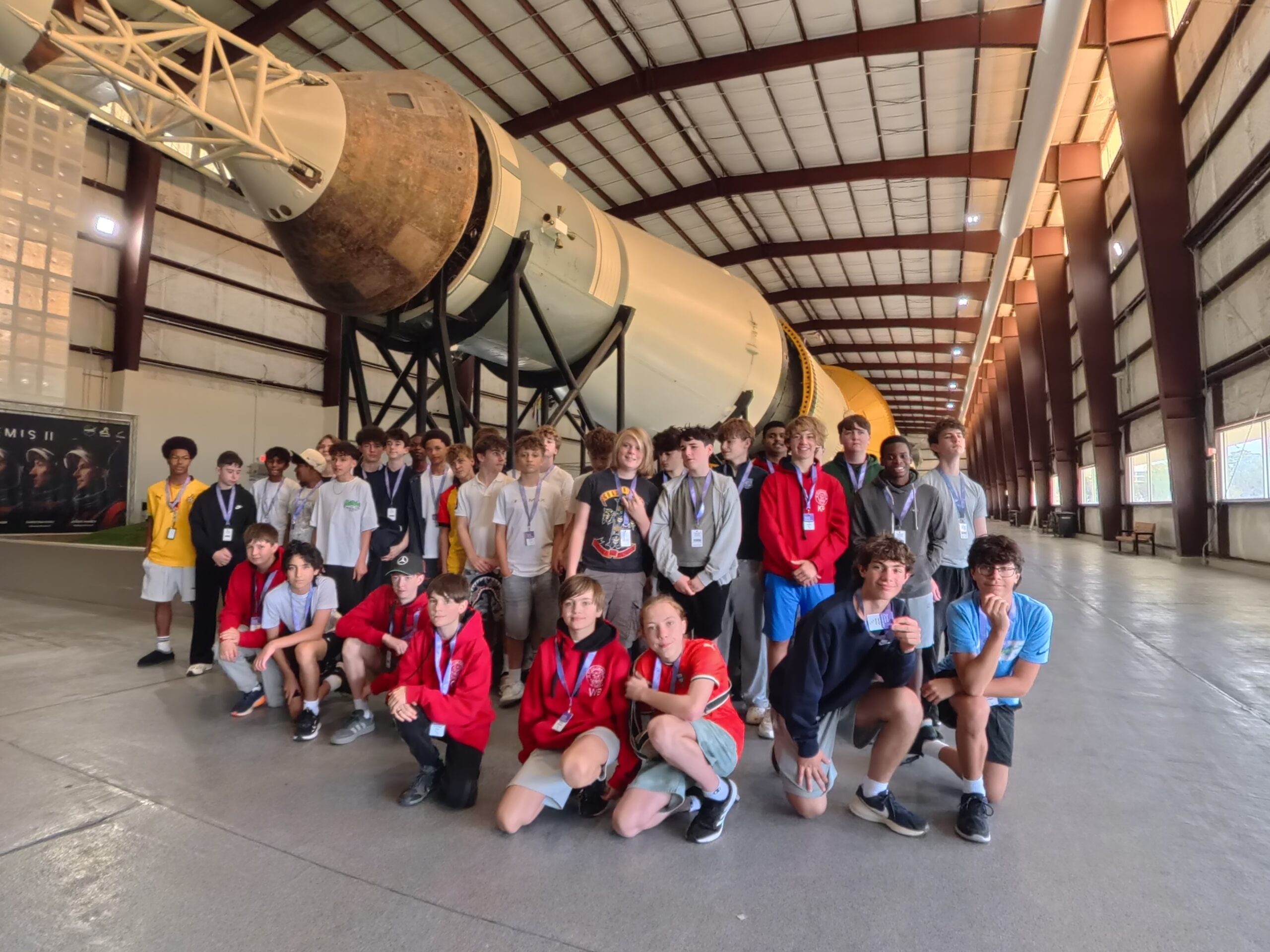
One of our most exciting opportunities is NASA Space Centre University in Texas. Watching students launch rockets, programme robots and experience astronaut-style weightlessness training is incredibly rewarding. We are also developing links with universities and industry partners to continue expanding what STEM can offer our students. It is an exciting time for STEM at St Columba’s and I’m looking forward to seeing it grow even further in the coming years.
- Our GCSE and A Level results in STEM subjects are outstanding. What do you think sits behind that success?
I think there are several factors behind our success, but first and foremost it’s the people. We have dedicated students who are willing to challenge themselves and passionate teachers who genuinely love their subjects.
Our teachers are experts in their fields, but more importantly, they work hard to make learning relevant and engaging. Students can see how the knowledge they are learning applies beyond the classroom, which helps them develop a deeper understanding and appreciation of their subjects.
I also believe our wider STEM provision plays a significant role. Because students are exposed to practical experiences, competitions, enrichment activities and real-world applications, they often develop a stronger understanding of concepts and a greater enthusiasm for learning.
Ultimately, our success comes from creating an environment where students are encouraged to be curious, ambitious and resilient. Excellent results are a by-product of that culture.
- You recently took students on a trip to NASA. What did they experience, and what do trips like this add to their learning?
The NASA trip was genuinely one of the highlights of my teaching career and an experience that neither the students nor I will ever forget.
Our students spent a week at Space Center University based at the Johnson Space Center in Houston, Texas, completely immersed in the world of space exploration. They took part in a range of hands-on activities including cryogenics, robotic coding, building and launching rockets, and designing habitats for future missions to Mars.
A particular highlight was attending a talk by former NASA astronaut Mark Polansky, who flew on three Space Shuttle missions: Atlantis, Discovery and Endeavour. Hearing first-hand about his experiences in space, the challenges he faced, and the teamwork required for successful missions was fascinating and really helped bring STEM to life for our students.
Students also took part in astronaut-style scuba diving activities, learning some of the techniques astronauts use during training. Watching them support one another, solve problems and grow in confidence throughout the week was incredibly rewarding.
What stood out most to me was how every student embraced the experience. Some arrived perhaps not seeing themselves as particularly interested in STEM, yet by the end of the week they were confidently discussing space exploration, engineering challenges and life on Mars. They threw themselves into every activity, supported one another and graduated from Space Centre University with a real sense of pride and achievement.
Trips like this show students that STEM is far more than a collection of school subjects. It is about exploration, innovation, teamwork and pushing the boundaries of what is possible. Experiences like NASA allow students to see where their learning can take them, inspire future aspirations and create memories that will stay with them long after they leave St Columba’s. As a teacher, there is nothing more rewarding than seeing a student’s eyes light up when they realise that these opportunities and careers could genuinely be part of their future.
- STEM is constantly evolving. How do we make sure our students are prepared for the technologies, careers and opportunities of the future?
The reality is that many of the careers our students will go into may not even exist yet. Because of that, our focus isn’t just on teaching knowledge, but on developing adaptable, creative and resilient young people.
We want students to be confident problem-solvers, effective communicators and curious learners who are comfortable working with new technologies and ideas.
Part of this involves building strong connections with industry and higher education. Recently I attended a STEM conference at the University of Hertfordshire, where I had the opportunity to visit their outstanding engineering facilities, including robotics laboratories, flight simulators and Formula One-related projects. Experiences like this help us identify exciting opportunities that we can bring back to our students.
We are also fortunate that our Form 3 students take part in a dedicated STEM day as part of their EECA programme, giving them the opportunity to work creatively and collaboratively on STEM-based challenges from an early age.
As STEM continues to evolve, we will continue to evolve alongside it. We are always looking for new partnerships, new challenges and new opportunities that will help prepare our students for whatever the future holds. I am particularly excited about the relationships we are beginning to build with universities and industry partners, which I believe will create some fantastic opportunities for our students in the years ahead.
- For a student who might not see themselves as a ‘STEM person’, what would you say to encourage them to give it a go?
I would tell them that there is no such thing as a typical STEM person.
One of the biggest misconceptions is that STEM is only for people who see themselves as mathematicians, scientists or engineers. In reality, STEM needs creative thinkers, designers, communicators, innovators and problem-solvers. Some of the most successful students I’ve worked with have simply been curious and willing to give something a try.
The beauty of STEM is that it is everywhere. Whether you’re interested in sport, fashion, gaming, architecture, medicine, sustainability or space exploration, STEM plays a role.
My advice would simply be to get involved and have a go. Don’t worry about getting everything right first time. Some of the best learning happens when things don’t quite go to plan and you have to rethink, adapt and try again.
I’ve seen students surprise themselves time and time again when they’ve stepped outside their comfort zone. Watching students discover a passion or talent they didn’t know they had is one of the most rewarding parts of my role.
At St Columba’s, we’re working hard to make STEM an increasingly visible and exciting part of school life. There are some really exciting developments ahead and I hope every student feels that STEM is something they can be part of, because ultimately STEM is for everyone. Whether a student’s future lies in engineering, medicine, design, business, sport, technology or a field that hasn’t even been invented yet, STEM helps develop the skills, confidence and curiosity that will help them succeed.


